

As a photographer, you can present your creativity with reflection photographs. You can play with the depth, intrigue, and symmetry of your subject in reflection photos. For instance, it can be a calm image of the blue sky reflected in a lake, or an innovative subject shot with a glass or a mirror, and you get new ideas for your visual story.
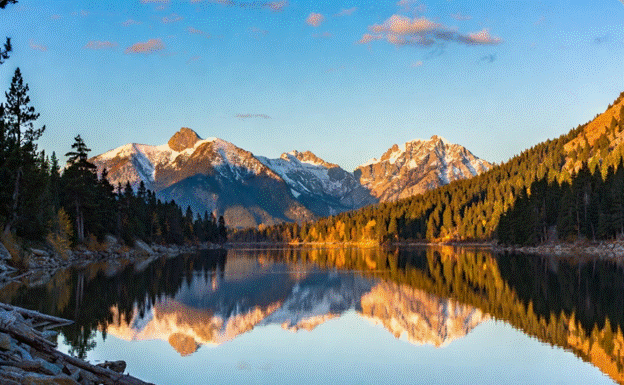
This blog is a guide on how to shoot reflection photographs. It also teaches you important techniques and measures of reflection photography. Practical reflection photography tips will help you to get innovative ideas.
What is Reflection Photography?
You can reflect your subject on a water body, a piece of glass, a mirror or other shiny surfaces to take a photo. A reflection photograph can complement the original subject, or it can also become the main attraction.
These photos create a visual interest for the onlookers. Your subject can be a landscape, a product or a street. Reflection photography makes the subject more artistic and visually pleasing.
Why is Reflection Photography So Interesting?
Three main factors make your visual photograph aesthetic and pleasing.
- Artistic and abstract composition
- Dimension and depth of your visual
- Your own skills in creating balance and symmetry
You can add an extraordinary touch to any subject with reflection photography. For instance, taking a picture of a street shop after heavy rain, focusing on the shop’s reflection in the street’s water.
Important Techniques for You
1. Use the Natural Reflection of Water
Use water around you to capture a reflection. Lakes, ponds, and even temporary puddles after heavy rain can become your reflective surface.
Reflection photography tips:
- Shoot when the water is still
- Puddles after rain are best for urban shooting
- You can better express the reflection with a low camera angle
2. Mirror Experiments
A mirror can provide you with endless options for reflection shooting. Use a handle mirror for strategically placing it as a reflector against your subject.
Ideas:
- Capture a wide landscape image in a small mirror; hence, you can have a surreal effect.
- You may also use an infinity mirror without frames to create that “endless expression”.
- A portrait shoot with mirror reflection helps you to present more than one perspective.
3. Shooting Through Glass
Take photos through glass to create a layered image. Glass helps you to combine both subjects that are in front and behind.
Try this technique on car windows, shop windows, and glass buildings. You can adjust the reflection vs. transparency factor with your camera angle.
4. Look Around for Unconventional Reflective Things
There are lots of things around you that can work as an unexpected reflector. For instance,
- Use wet streets
- Your mobile screen
- Sunglasses
- Other types of metallic objects
Your ability to select unique surfaces creates eye-catching visuals and interesting plots.
5. Reflection Present Visual Summetry
You can use reflection as a symmetry to your subject. As a result, it brings visual balance and becomes more appealing to the viewers.
Process:
- Place the horizon line in the centre; this will bring perfect symmetry to your photograph.
- Make sure your photograph guides the viewer’s eyes towards the reflection.
- You can also break the symmetry at your own will to create more dynamic visuals.
Set Your Camera
Your camera was like your primary tool to craft an innovative reflection photograph. Now, to capture innovative photographs, you need the right settings. For instance, setting your aperture, shutter speed, and ISO levels based on subject and vision.
- Aperture
If you are all into reflection, then change the default aperture f/8 to f/16. This will help you to make the reflection sharper.
- ISO
Low ISO, like 100 to 200, maintains the reflection quality of your subject.
- Shutter Speed
If you are planning a sharp reflection image, then go for a faster shutter speed. On the other hand, if you are planning a mild and dreamy reflection photograph on a water body, then select a slow shutter speed.
Lighting is Important
Lighting plays a crucial role in making creative reflection photos.
Various lighting conditions:
- Blue hours bring you good city reflections with street lights.
- Golden hours create that soft, warm reflection
- Direct daylight reduces harsh shadows and glares.
Although you can avoid shooting in midday, as harsh sunlight often ruins the reflection.
Some Reflection Photography Tips for You
- You need to change your perspective, for example, avoid shooting everything in high level. Rather, you can play with your camera angle, tilt your camera, or take a reverse vertical photo.
- Some reflection is more interesting then original subject. Thus, you need to consider and understand such a situation and keep your focus on the reflection.
- If you are applying a polariser, be careful. Adjust it in such a way that it does not eliminate the reflection.
- Reflection photos elevantes when you add a human subject. It will make your reflection photograph engaging.
Look into These New Reflection Photography Ideas
- For advanced reflection photographs, you can use a broken mirror to add an abstract touch.
- City light reflection on the street after rain is an interesting subject.
- Shoot a reflection inside a water droplet.
- Use a sunglass for the double exposure effect.
Avoid These Mistakes
As a beginner, you can make a few common mistakes in reflection photography. Hence, be causes about these mistakes and avoid them.
- Do not ignore the background; a wrong background can ruin the whole image.
- Make sure you’re shooting with the correct angle; the magic of camera angle decides your photo quality.
- Reflection should be natural, so avoid over-editing.
Creativity Has No Boundaries
Reflection photography is a field where your technical skill helps to bring creativity. Here, your options are limitless; you can shoot a reflection in a calm water body, click urban reflections with a mirror or from a puddle of water after rain, and do your own experiments with mirror angles.
You have to learn to observe your surroundings to find the right reflection. Even a small reflective object can bring abstract emotion to your subject. If you are keen to learn more advanced techniques in reflection photography, you can enrol in advance photography course in Kolkata. You can learn from professional photographers and receive expert guidance through this opportunity.
Start observing your surrounding a do not skip any reflective object without a second glance. These objects can play a major part in your next visual story.